

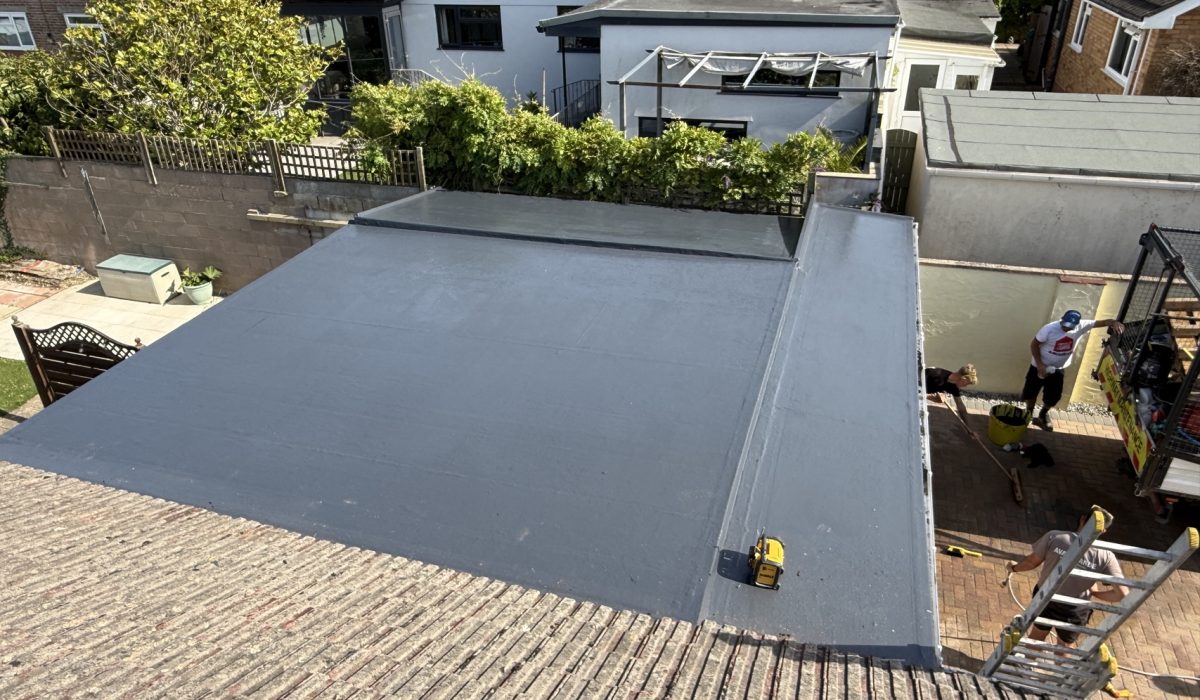
If you’re planning a new flat roof, on an extension, a dormer, or a garage, the choice usually comes down to two materials, EPDM rubber and GRP fibreglass. Both are a big step up from old felt roofing, and both will serve you well for decades, but they suit different roofs and different priorities. Here’s a straight comparison to help you decide which is right for yours.
EPDM vs GRP at a glance
| EPDM rubber | GRP fibreglass | |
| Installation | A single sheet, glued down, quicker and less weather dependent | Layered resin and fibreglass mat, cannot be laid in wet weather |
| Flexibility | Very flexible, handles movement and uneven decking well | More rigid, less suited to very large or uneven roofs |
| Joints | Comes in large sheets with very few joints | Fully bonded and seamless once cured |
| Repairs | Straightforward, a patch or sealant usually does it | More involved, needs sanding, resin and a new topcoat |
| Appearance | A plain, dark rubber finish | A smoother, cleaner finish, available in a few colours |
| Coastal weather | Excellent, naturally resists salt air and UV | Good, though some colour fading can occur over time |
| Typical lifespan | 30 years or more | 25 to 30 years |
| Typical cost per m² (installed) | £180 | £200 |
These figures are a guide rather than a quote, the right price for your roof depends on its size, shape and access.
Why EPDM often suits North Devon homes well
Being this close to the coast, salt laden air is a real factor in how any roofing material ages, and EPDM handles it particularly well. Its rubber composition resists UV and salt water without the surface fading or breaking down the way some materials can, which makes it a strong choice for anything within reach of the coastline, from Woolacombe and Croyde to Ilfracombe and Instow.
Why GRP is still a great choice
GRP earns its place too, especially where appearance matters or the roof has a more complex shape with upstands, kerbs or unusual detailing. Its fully bonded, bright finish gives a tidy look that suits visible areas like a garden room or a porch roof, and it handles detailing around chimneys, rooflights and abutments neatly. The trade off is that it takes longer to install and can’t go down in wet weather, so it needs a settled forecast.
Which should you choose
If your roof is large, has an unusual shape, or sits somewhere exposed to salt air and driving rain, EPDM is usually the more forgiving choice. If you want the tidiest possible finish on a smaller, more visible roof and can work around the weather for installation, GRP is well worth considering. Honestly, the best answer depends on your specific roof, which is why we’ll always take a proper look before recommending one over the other rather than pushing whichever we happen to have in stock that week.
Frequently asked questions
Is EPDM or GRP better for a flat roof?
Neither is universally better, they suit different situations. EPDM tends to handle larger, less regular roofs and coastal exposure well, while GRP gives a smarter finish on smaller, more visible roofs. We’ll recommend whichever suits your specific roof once we’ve assessed it.
Which lasts longer, EPDM or GRP?
EPDM typically lasts 30 years or more, while GRP typically lasts 25 to 30 years, though both depend heavily on the quality of installation and how well the roof is maintained.
Is EPDM cheaper than GRP?
Usually, yes, EPDM tends to sit slightly below GRP on a cost per square metre basis, though the exact figure depends on your roof’s size and how easy it is to access.
Can EPDM or GRP be repaired if damaged?
Yes, both can be repaired. EPDM is generally the more straightforward of the two to patch, while GRP repairs involve a bit more work to sand back, resin and recoat the damaged area.