

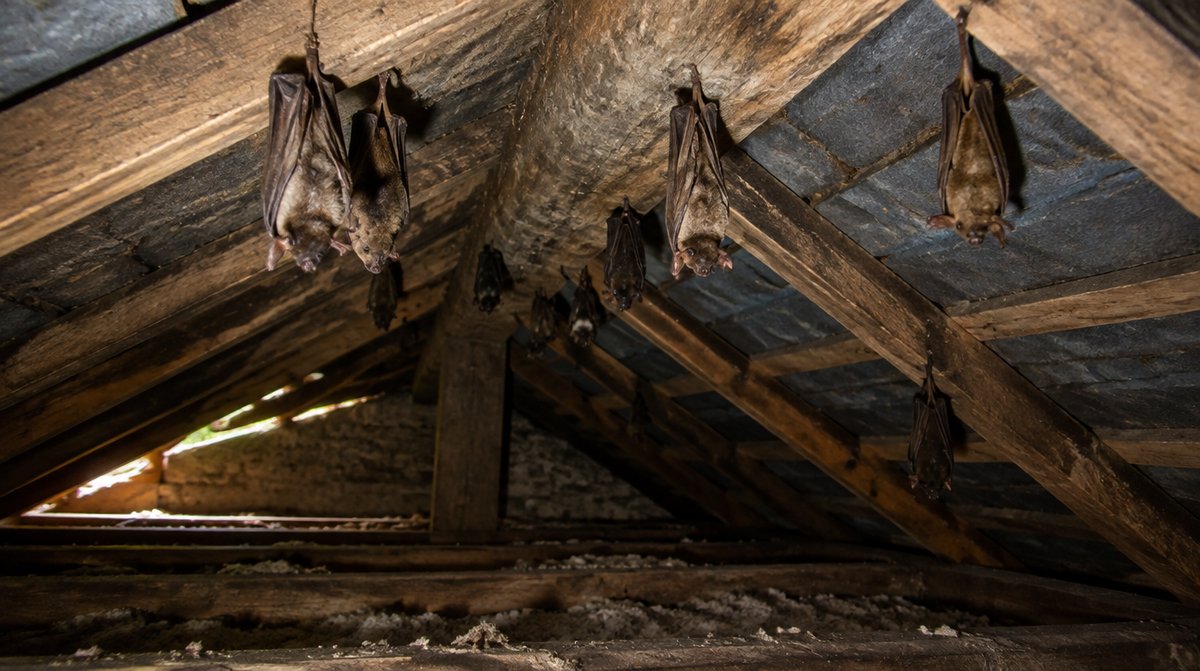
Found droppings in your loft, or noticed something flying out from the roof at dusk? It might well be bats. It’s more common than people think, especially in rural North Devon, and it doesn’t mean your roof can never be repaired or replaced. It does mean there are some important legal points to know, and any roof work needs to be planned properly.
Here’s what to look for, what the law says, who to contact and how roof work can still go ahead.
Signs you might have bats
Bats are small and come and go around dusk, so many people never actually see them. Signs to look out for include:
- Small, dark droppings in the loft, on window sills or stuck to the walls below the eaves. They look a bit like mouse droppings but crumble to a fine dust when crushed, because they’re made of insect remains.
- Bats flying out from under slates or tiles, soffits, gable ends or around the chimney at dusk, usually between May and September.
- Scratching or squeaking from the roof space around dusk or dawn.
- A faint, musty smell in the loft.
- Staining or grease marks around small gaps where bats squeeze in and out.
Bats don’t chew wires or timber and they don’t build nests, so they don’t damage your roof.
Why bats are protected by law
All UK bat species are protected under the Wildlife and Countryside Act 1981 and the Conservation of Habitats and Species Regulations 2017. As European protected species, they have some of the strongest legal protection of any wildlife in the UK.
In simple terms, it’s against the law to:
- Deliberately disturb, harm or kill a bat
- Damage, destroy or block access to a roost
A roost is protected whether or not bats are there at the time, so a loft bats use in summer is still protected in winter. It doesn’t matter whether you knew the roost was there or not. Breaking these laws can lead to a large fine, and in serious cases prison.
Having bats in your loft isn’t illegal in itself. It just means any work that could affect them has to be done the right way.
What not to do
- Don’t block up any gap you think bats are using
- Don’t try to move, handle or remove a bat yourself. If you find one on the floor or one that seems injured, don’t pick it up with bare hands
- Don’t carry on with roof repairs, reroofing, loft insulation, timber treatment or a loft conversion if you think bats are present
- If you’re partway through building work and come across bats or their droppings, stop work and get advice before carrying on
Disturbing a roost, even by accident, can be an offence, so it’s always better to stop and ask.
What to do if you find bats
- Leave them alone and hold off on any work.
- Call the National Bat Helpline, run by the Bat Conservation Trust, on 0345 1300 228. It’s free, and they can give advice over the phone or arrange for a volunteer bat roost visitor to come and take a look.
- If you’re planning work, get a bat survey from a qualified ecologist. You can find one through the Chartered Institute of Ecology and Environmental Management (CIEEM).
- Tell your roofer straight away so it can be built into the plan from the start.
Bat surveys and licences
If roof work could affect bats, you’ll usually need a bat survey before anything starts. The ecologist will check whether bats are using the roof, which species they are and how they use it.
Surveys are most reliable in the active season, roughly May to September, so if you’re planning roof work for next year it’s worth getting the survey booked early rather than once work is already underway.
If the survey finds a roost that can’t be avoided, the ecologist will help you apply for a mitigation licence from Natural England before work goes ahead. The licence sets out how and when the work can be done and what needs to be put in place to protect the bats. That can include timing the work for when bats aren’t present, having the ecologist on site, using a bat safe roofing membrane and fitting bat access points.
Why bat safe membranes matter
Many modern breathable roofing membranes aren’t suitable where bats roost, because bats can get their claws caught in the fibres. In roofs used by bats, a bat safe membrane, often a traditional type 1F bitumen felt, is usually specified. Your ecologist will tell you what’s needed.
How roof work can still go ahead: our Umberleigh job
On a recent full reroof in Umberleigh, we found a lot of bats living in the roof space when we opened it up. We worked alongside the ecology team from start to finish to keep them safe while the old roof came off and the new one went on.
The new roof has a 1F bat safe felt, treated timber battens and grey green Brazilian slate, hook fixed, with all hips and ridges bedded in mortar. We fitted bat vents on the two larger elevations so the bats can keep using the roof in future.
Our client ended up with a brand new roof, and the bats kept their home. That’s how it should work.
Frequently asked questions
Is it illegal to have bats in my loft?
No. Having bats in your loft isn’t illegal. What’s illegal is disturbing or harming them, or damaging or blocking their roost, so the main thing is to plan any roof work carefully.
Can I remove bats from my loft myself?
No. Don’t try to remove or handle bats yourself. Contact the National Bat Helpline for advice. If bats genuinely need to be excluded, that has to be done under a licence from Natural England.
Do I need a bat survey before roof work?
If there’s any sign bats are using your roof, yes. A survey by a qualified ecologist is the safest way to find out what’s there before repairing, replacing or insulating a roof.
Will bats delay my roofing project?
It can add some lead time, mainly because surveys are most reliable between May and September. Booking the survey early keeps delays to a minimum.
Planning roof work and think you might have bats?
We’ve worked on roofs with bats before, and we know how to plan a job around surveys, licences and ecologists so it goes smoothly. Get in touch and we’ll talk you through it, and work with your ecologist if a survey or licence is needed. We cover Umberleigh, Chulmleigh, Barnstaple and the whole of North Devon.
Call us on 01271 359259 or get in touch through our contact page.